
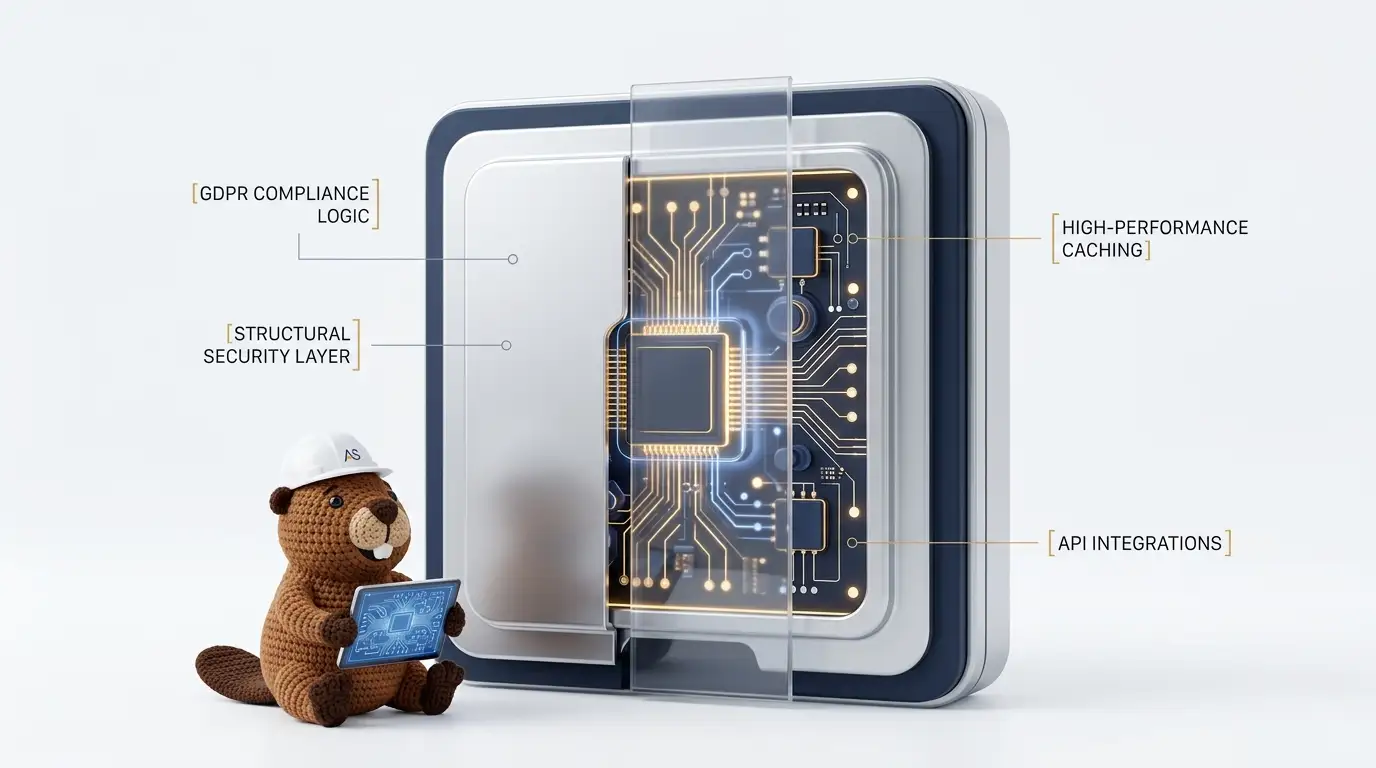
The Silent Guardians: Why Backend Infrastructure is Your Best Salesperson 🏗️
When we talk about web design, the conversation usually gravitates toward “curb appeal”—the sleek typography, the vibrant color palette, and the smooth animations that catch the eye. But as a Digital Architect, I know that the most beautiful house in the world won’t stand if the foundation is cracked and the wiring is faulty.
In the digital realm, this foundation is your Invisible Infrastructure. This is the collection of plugins, scripts, server configurations, and legal protocols that work behind the scenes. This week at Art Spot Web Studio, we are opening the “Engine Room” to look at the three pillars that keep your business safe, fast, and compliant: Security, GDPR, and Caching.
1. The GDPR Fallacy: It’s Not Just a Sticker 🛡️
Let’s address the elephant in the room. There is a common misconception that GDPR compliance is either optional for small businesses or that it can be solved with a tiny banner in the corner of the screen.
The reality is much more complex. A simple sentence saying “We use cookies” does not make you compliant. For example, many owners don’t realize that something as simple as embedding a YouTube video or loading a Google Font constitutes a data transfer. The moment a visitor’s IP address is sent to an external server to fetch that font or video stream, you are tracking them.
Under the law, this requires prior consent. If your infrastructure isn’t engineered to “pause” these elements until the user explicitly agrees, your banner is effectively useless. True GDPR compliance involves:
- Consent Management: Implementing logic so scripts are held back until authorized.
- The Documentation Trail: Having dynamic Privacy Policies that reflect the real-time behavior of your site.
- Data Mapping: Understanding exactly where your user data goes—whether it’s to a newsletter tool or an analytics server.
2. Security as Architecture 🔒
Most site owners think of security as a “deadbolt”—a single plugin or a strong password. While those are important, true security is structural. It starts with clean code and extends to how your “invisible” systems communicate.
A secure site doesn’t just protect data; it protects your brand’s reputation. One breach can undo years of client trust. We build with a “Zero Trust” mindset. This means every plugin is vetted for “spaghetti code,” every entry point is hardened, and SSL handshakes are optimized for both safety and speed. If the “guts” of your site are messy, your security is hollow.
3. Caching: The Physics of Speed ⚡
If security is the foundation, caching is the high-performance engine. Caching is essentially “digital memory.” Instead of your server building your website from scratch every time a visitor arrives, caching allows it to serve a “pre-built” version in milliseconds.
Statistics show that a 1-second delay in load time can lead to a 7% reduction in conversions. In a world of short attention spans, speed is your most effective salesperson. We optimize the invisible—database queries and script minification—so your users stay focused on your message, not your loading bar.
4. The “Template Trap”: Why DIY Isn’t Always Compliant ⚠️
I often meet business owners who have built their own sites or purchased a template, thinking they are fully covered. While I totally support them, because the tool that you will create will fit you, I need to write a word of warning for the “ready made” sites. They sincerely believe that because the template was sold as “ready,” they don’t need to worry.
The truth is, the moment you “mingle” with the code, add a new plugin, or embed a third-party service, you change the digital footprint of your site. If you aren’t an engineer, it’s easy to overlook the fact that your site is leaking data to third parties every time a page loads. At Art Spot, we don’t just hope a template works; we verify that every brick we add is structurally sound.
Conclusion: The Architect’s Promise 🏛️
Craftsmanship isn’t just about what you see on the homepage. It’s about the clean logic in the backend and the stability of the systems supporting it. We handle the technical “guts” of the build so that your digital structure stands the test of time.